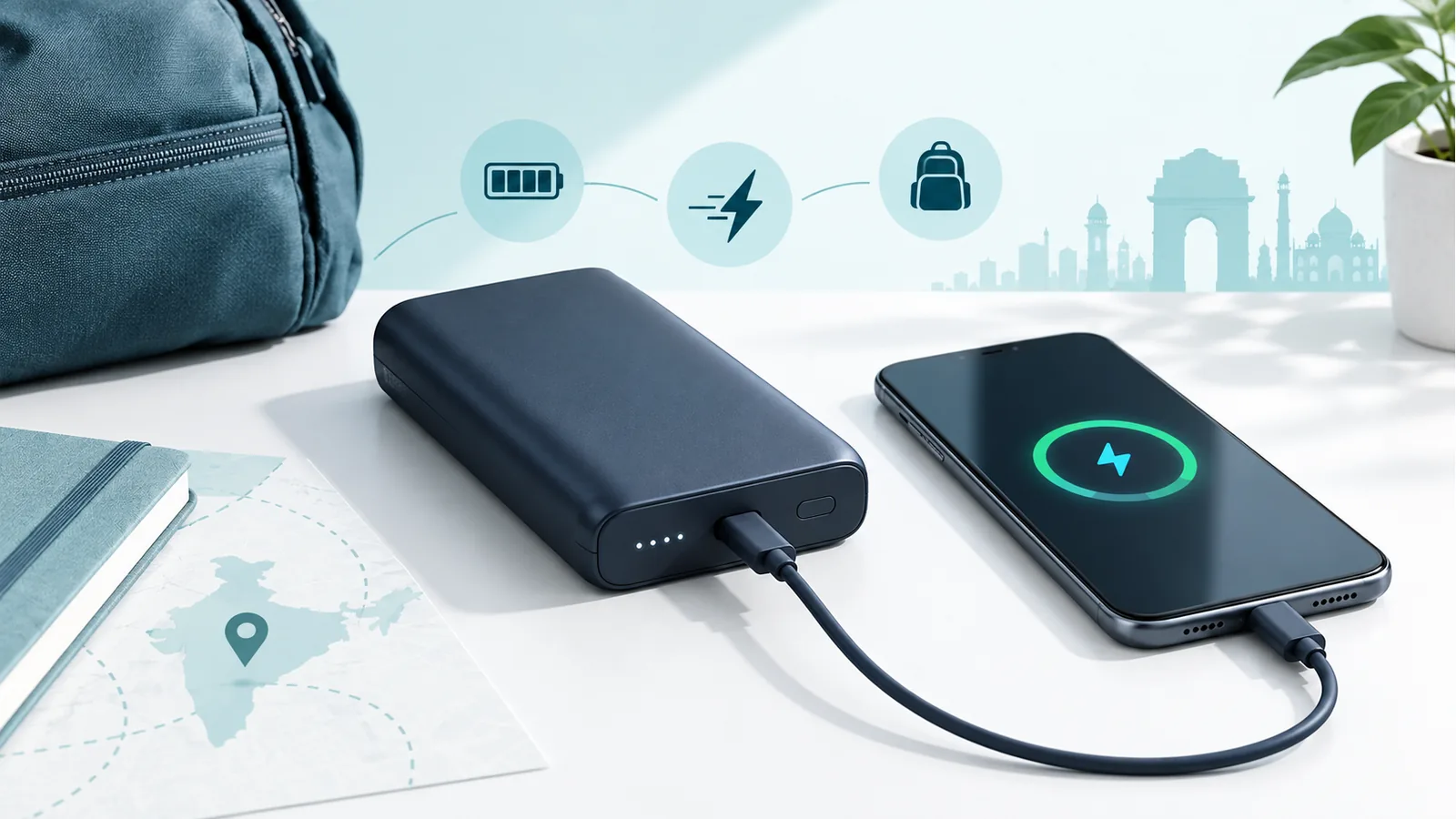
What a power bank actually does
A power bank stores electrical energy in rechargeable cells and supplies that energy through one or more output ports. You charge the power bank from a wall charger, then use it to recharge a phone, earbuds, watch, tablet or another compatible device when a socket is unavailable.
It is best understood as a portable reserve, not as a replacement for a suitable wall charger. How quickly it recharges a device depends on the power bank's stated output, the charging standard shared with the device, the selected port and the cable. How quickly the power bank itself refills depends on its input specification and the wall charger used.
Start with capacity: 10,000mAh or 20,000mAh?
A 10,000mAh power bank is often the practical choice for commuting, a day trip or emergency backup. It will generally be smaller and lighter than a comparable 20,000mAh model. It can suit someone who carries one phone and can recharge the power bank regularly.
A 20,000mAh model stores more energy and may be more useful for longer journeys, several devices or days with unreliable access to power. The trade-off is usually more weight, more bulk and a longer time needed to refill the power bank. Capacity alone does not determine quality or speed, so avoid choosing only by the largest printed mAh figure.
Why advertised capacity is not exact usable output
The advertised capacity normally describes the internal battery cells under their rated conditions. A USB device charges at a different voltage, so the power bank must convert the stored energy before delivering it. Some energy is lost through that conversion, the cable, heat and the receiving device's own charging process.
For that reason, dividing the printed power-bank capacity by your phone's battery capacity will not give an exact number of full charges. Compare models using published rated energy or rated output information when available, and treat simple “number of charges” claims as estimates rather than guarantees.
Check the ports carefully
USB-A and USB-C
USB-A is the larger rectangular connector found on many older chargers and cables. It remains useful if your existing cable has a USB-A plug. USB-C is smaller and reversible, and it is increasingly used for both charging the power bank and charging connected devices.
The connector shape does not by itself prove charging speed. A USB-C port can have different power capabilities, and a USB-A port may support a fast-charging protocol. Read the published input and output figures for each individual port instead of assuming all ports perform alike.
USB-C input-only versus input/output
An input-only USB-C port can recharge the power bank but cannot send power to your phone. An input/output port can work in both directions. Product listings sometimes highlight “Type-C” without making this distinction obvious, so look for separate input and output specifications or clear port labels.
If you want to carry one USB-C-to-USB-C cable, choose a model that explicitly states USB-C output. This is especially important for devices that expect USB Power Delivery over USB-C.
Understand input wattage and output wattage
Output wattage describes the maximum power the power bank states it can provide under supported conditions. Input wattage describes how quickly the power bank itself may recharge. A model can offer fast phone charging but slow self-charging, or the reverse.
The printed maximum is not a promise that every device will receive that rate. The phone, power bank and cable negotiate or share a compatible charging mode. When several output ports are used together, the total power may be divided, and individual ports may slow down. Check both the single-port and combined-output information if you plan to charge multiple devices.
USB Power Delivery and Quick Charge
USB Power Delivery, documented by USB-IF, allows compatible equipment to negotiate flexible power delivery over USB. A power bank marked PD is most useful when your phone, tablet or other device also supports a compatible PD mode and you use a suitable cable.
Quick Charge is a separate fast-charging technology associated with Qualcomm. The official Qualcomm Quick Charge information explains that compatible equipment dynamically manages power and that certified accessories matter. Do not assume that “fast charging,” PD and Quick Charge are interchangeable labels. Check the charging standard supported by your exact phone model.
Phone and cable compatibility
Start with the charging specifications published for your phone or tablet. Then find a power-bank output that supports the same standard and an appropriate power level. A power bank with a higher maximum output normally does not force that maximum into a device; compatible equipment uses an agreed level. However, an unsupported protocol may result in ordinary charging rather than the advertised fast rate.
Cables also have limits. A damaged, poorly made or unsuitable cable may charge slowly, disconnect or become warm. Use a sound cable intended for the required connector and charging level, and replace cables with loose plugs, cuts or exposed conductors.
Built-in cables: convenient but not automatically better
A built-in cable reduces the number of separate items you need to carry. It can be convenient for daily travel and avoids arriving with a charged power bank but no cable. Some designs also use the cable as a short carrying loop.
The limitation is repairability. If a fixed cable becomes damaged, replacing it may be difficult or impossible even if the battery still works. It may also be too short for comfortable use or support only one connector type. Check whether ordinary output ports remain available as a backup and whether the built-in cable supports both the connector and charging mode you need.
Size, weight and portability
Product photographs can make different models look similar, so consult published dimensions and weight before buying. A large-capacity power bank may be comfortable in a backpack but inconvenient in a trouser pocket. Rounded edges, a secure surface and clearly placed ports can matter during everyday use, although these qualities are difficult to judge from specifications alone.
Choose for the journey you make most often. A lighter 10,000mAh unit carried every day can be more useful than a 20,000mAh unit regularly left at home. Conversely, the larger reserve may justify its weight for long travel or several devices.
What pass-through charging means
Pass-through charging means a power bank can receive power while also supplying power to another device. Support varies by model, and manufacturers may impose limits on ports, speed or operating conditions. The arrangement can generate additional heat and may charge both batteries more slowly than charging them separately.
Do not assume the feature is present unless the manufacturer explicitly documents it. If it is important for your setup, read the model's manual and follow its instructions rather than relying on a seller-page label alone.
Safety features and responsible use
Look for published protection against conditions such as excessive current, excessive voltage, short circuits, overcharging and unsafe temperature. Protection claims should be supported by clear manufacturer documentation rather than vague phrases. For the Indian market, the Bureau of Indian Standards registration information is a useful starting point when checking applicable product safety requirements.
Buy from a traceable seller, keep the invoice and inspect the unit when it arrives. Stop using a power bank that is swollen, cracked, leaking, unusually hot, smells abnormal or has damaged ports. Keep it away from water, direct heat and crushing loads. Do not cover it with bedding while charging, and use chargers and cables that meet the manufacturer's stated requirements.
Airline travel considerations
Power banks contain lithium batteries and are subject to airline and aviation-safety rules. Requirements can depend on the battery's watt-hour rating, route, airline and applicable national rules. Policies also change, so a rule remembered from an earlier trip may no longer apply.
Before flying, check your airline's current baggage page and authoritative guidance such as IATA guidance for power banks. Follow instructions about where the power bank must be carried, whether approval is required and how terminals should be protected. Make sure the capacity or watt-hour marking is readable. This guide intentionally does not substitute a fixed limit for the rules that apply to your particular journey.
Warranty, seller and return-policy checks
Check the warranty duration, who provides service in India, what proof of purchase is required and whether battery-capacity loss is covered. Confirm that the seller is identifiable and that the listing describes the exact model you intend to buy. Similar model names can hide different ports or charging capabilities.
Read the current return and replacement policy before ordering, especially for products that may be classified differently once opened or used. Save the invoice, packaging, serial information and support details until you have verified charging, ports and physical condition.
Practical power-bank checklist
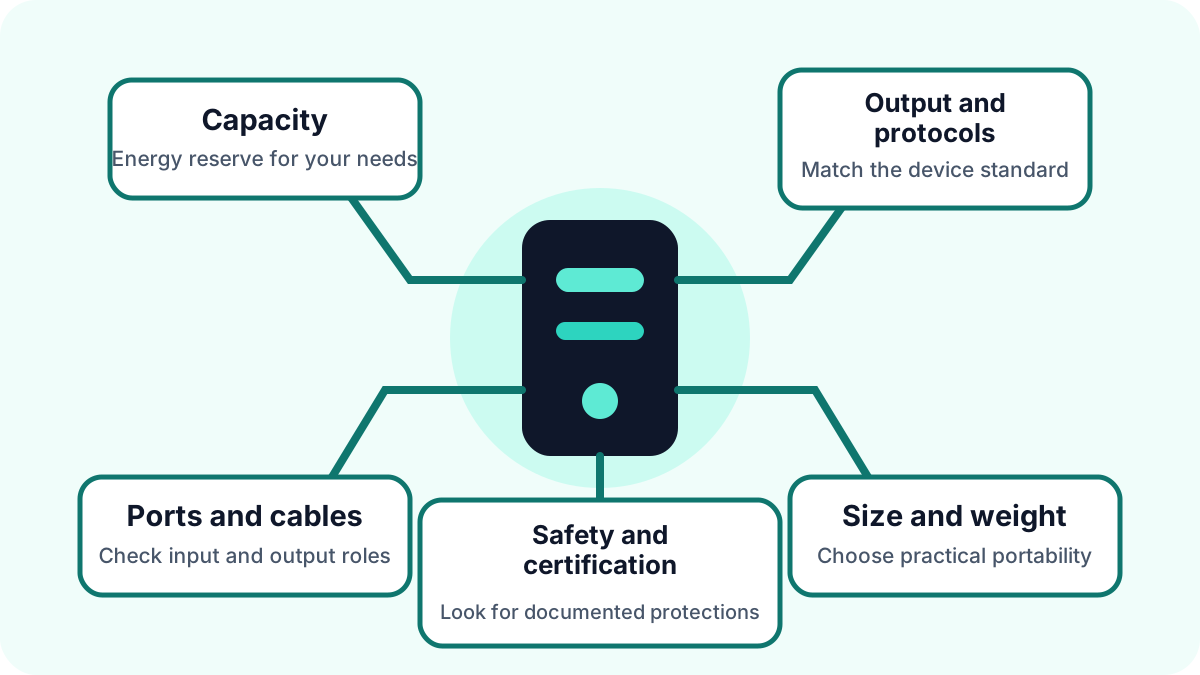
- Decide whether portability or a larger energy reserve matters more.
- Check the published capacity, rated energy and rated output information.
- Confirm which ports are inputs, outputs or both.
- Match PD, Quick Charge or another stated protocol to your device.
- Check single-port and combined-output wattage.
- Choose a suitable, good-condition cable.
- Review published dimensions and weight.
- Check documented electrical and temperature protections.
- Verify seller identity, warranty support and the current return policy.
- For flights, check the current airline and aviation guidance before travel.
Once you understand these points, you can compare Xiaomi, Amazon Basics and Ambrane 20,000mAh power banks using their stated features. If you also need a compact wall adapter, see our Stuffcool, Portronics and Ambrane 65W charger comparison.
Frequently asked questions
Is a 10,000mAh or 20,000mAh power bank better?
A 10,000mAh model is usually easier to carry, while a 20,000mAh model generally offers more reserve energy but tends to be larger and heavier. The better choice depends on your devices, time away from a socket and portability needs.
Why does a power bank deliver less than its advertised capacity?
The cell rating and the USB output use different voltages, and energy is lost during voltage conversion, cable transmission and charging. The advertised mAh figure therefore should not be treated as the exact amount delivered to a phone.
Does a USB-C port always support output charging?
No. Some USB-C ports recharge only the power bank, while others support both input and output. Check the port labels and published input and output specifications.
Can I take a power bank on a flight?
Airline and aviation rules apply to power banks because they contain lithium batteries. Check current airline and departure-country guidance before travel, carry the power bank as directed and protect it from short circuits.
Can I use a fast power bank with a slower phone?
Usually, compatible devices negotiate an appropriate charging level, but the cable, phone and power bank must support compatible standards. Charging falls back to the capability shared by the connected equipment.
Browse technology guides · Browse all buying guides · Everyday Helper home